WorkHeadlinerMar–Sep 2026
Agentic Payments Research
Six months of primary research into how AI agents pay each other over crypto rails, and an honest account of what shipped.

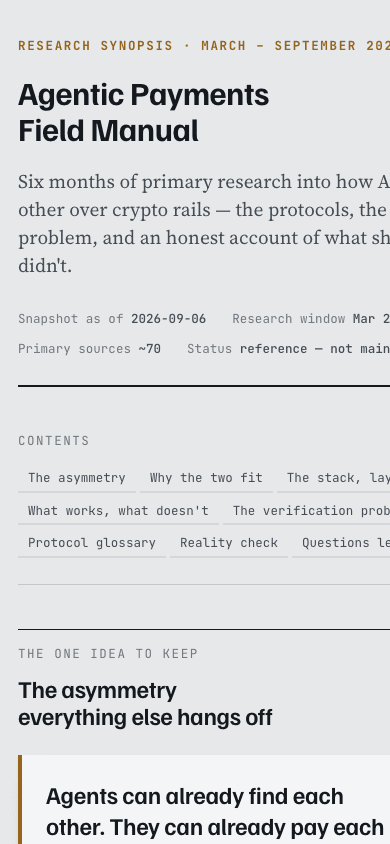
The Agentic Payments Field Manual, a single-page synthesis with dated figures and a contradictions section
- The Field Manual on a phone
01What I built
Between March and September 2026 I ran a research program on agentic payments: AI agents transacting with other agents, autonomously, using stablecoins and smart contracts. The main output was a milestone report (2026-03-23). I did not write it alone: I put it together with AI as a research tool, setting the questions and the source standard, having agents pull and organise the material, and reviewing and shaping what went in. It covers stablecoins, smart wallets, payment patterns, oracles and verification, chains and standards; a set of protocol reference notes; a map of the verification landscape split by what is verified, who renders the verdict, and when it fires; and five open questions logged with explicit probabilities rather than conclusions.
In September 2026 I cleaned it up into a public repository and a one-page Field Manual designed to be scanned rather than read start to finish. Every figure carries its date. The section I care most about is the one titled "the numbers that cut against the story": x402 daily transactions down 92% from the December 2025 peak, about half of remaining volume suspected wash trading, a $0.20 average transaction against the $5–50 my model assumed.
02What I learned
The finding I kept returning to: agents can already find each other and pay each other, and nobody has solved how a paying agent knows the work it bought was any good. The structural reason that layer stays empty is that payment rails earn on throughput and a quality gate reduces throughput.
I also learned to write my guesses down with numbers attached. On whether AI agents will end up sharing one identity standard, I wrote down a 45% chance it stays fragmented, 40% that one big player's version becomes the default, and 15% that a true standard exists within a year. Six months later I can check those against what actually happened, which you can't do with a vague hunch.
The other lesson was about chains. I always believed Solana would win, and the numbers agreed sooner than I planned for: Solana passed Base on daily x402 volume in January 2026. That is why the verifier was designed to work on any chain, not just one.
03Built with AI
The vault was built with Claude Code as the research assistant: I set the questions and the source standard (protocol specs, engineering blogs, on-chain data, filings, not secondary coverage), agents pulled and structured the material, and a session-capture hook recorded each working session into the vault automatically. The Field Manual HTML and the public repository were produced the same way, with me reviewing every claim for a date or a source before it shipped.
Solana relevance
The research recorded Solana overtaking Base on daily x402 volume by mid-January 2026 and running roughly 65% of year-to-date transactions, which became the basis for how I think about Solana's position in agentic payments. It also documents the gap most relevant to the Foundation's Pay.sh program: metered per-call access is not outcome verification, and the ecosystem moved toward that gap in 2026 rather than closing it.